
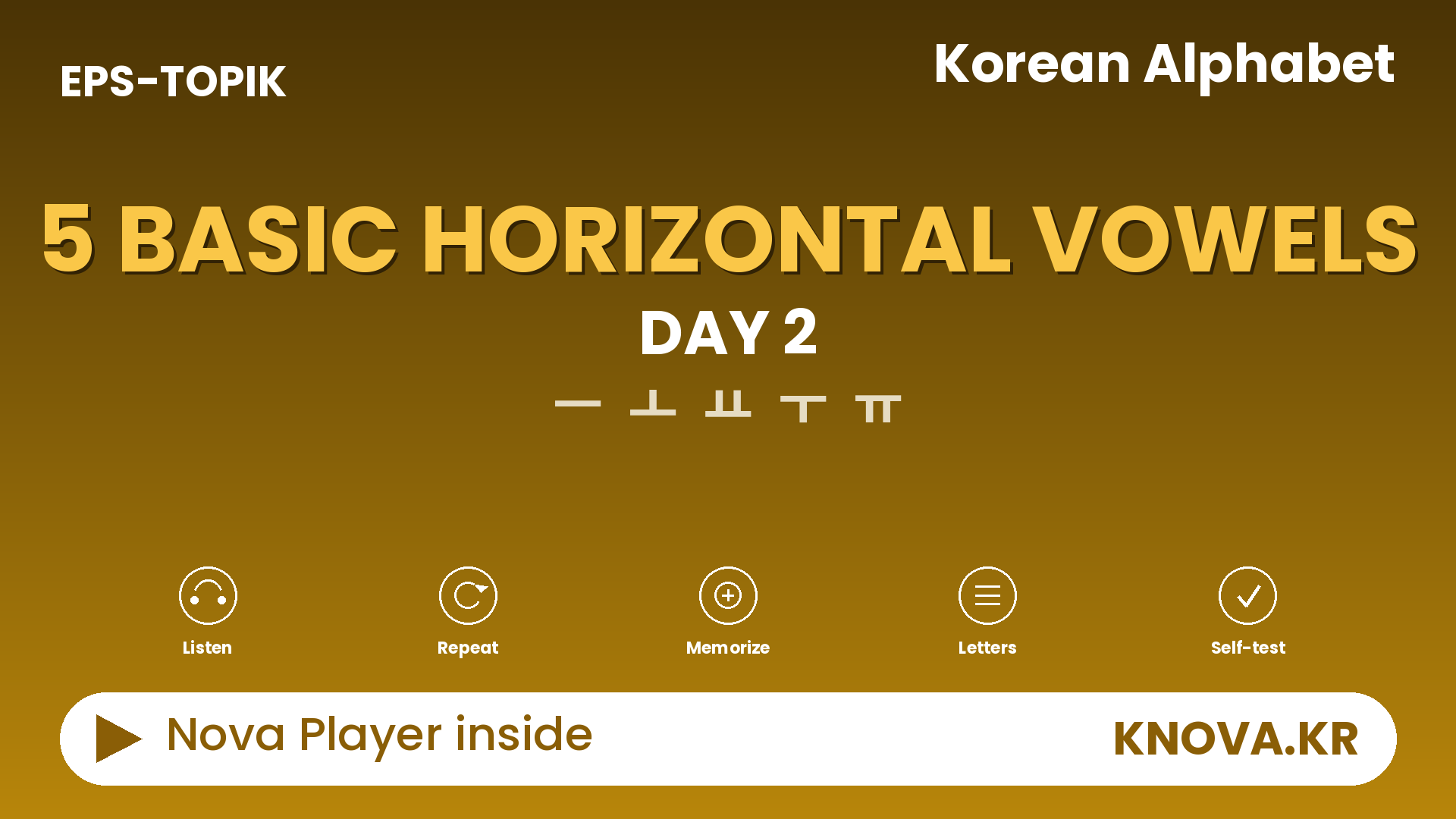
Welcome to Day 2 of the Korean Alphabet Master series! Yesterday you learned the vertical vowels — today, you will learn the 5 Basic Horizontal Vowels in Korean: ㅡ, ㅗ, ㅛ, ㅜ, ㅠ. These horizontal vowels are called “horizontal” because the vowel is written lying flat, right below the consonant. Once you finish these 5 Horizontal Vowels, you will have mastered all 10 basic Korean vowels! Let’s continue with Teacher Nova.
TAG: Maligayang pagdating sa Day 2 ng Korean Alphabet Master series! Kahapon, natutunan mo ang vertical vowels — ngayon, matututunan mo ang 5 Basic Horizontal Vowels sa Korean: ㅡ, ㅗ, ㅛ, ㅜ, ㅠ. Tinatawag itong “horizontal” dahil ang patinig ay nakasulat nang pahiga, sa ilalim ng katinig. Kapag natapos mo ang 5 horizontal vowels na ito, na-master mo na ang lahat ng 10 basic Korean vowels! Magpatuloy tayo kasama si Teacher Nova.
🚨 If you came from Facebook: Tap [⋮] on the top right and select “Open in external browser” to enable sound!
⚡ Teacher Nova’s Core Rule
ENG: Remember Rule 3 from the Golden Rules? Romanization is only a guide — focus on the ‘Real Korean Sound’ below and repeat it again and again.
TAG: Naaalala mo ba ang Rule 3 mula sa Golden Rules? Gabay lang ang Romanization — mag-focus sa ‘Real Korean Sound’ sa ibaba at ulitin ito nang paulit-ulit.
💡 Learn the Details: The Story of Hangul (Horizontal Vowels)
1. The Flat Ground: ㅡ
ENG: The letter ㅡ represents flat ground. Imagine Teacher Lee standing (ㅣ) and suddenly falling flat on the ground because of exhaustion, making the sound “ㅡ”! This sound does not exist in English, so it is very difficult for foreigners, but it plays a crucial role in Korean. You must master this completely at the beginning! Listen to the audio and repeat!
TAG: Ang letrang ㅡ ay kumakatawan sa patag na lupa. Isipin si Teacher Lee na nakatayo (ㅣ) at biglang natumba sa lupa dahil sa pagod, na lumilikha ng tunog na “ㅡ”! Ang tunog na ito ay walang katumbas sa English kaya napakahirap sa mga banyaga, ngunit napakahalaga nito sa Korean. Kailangan mong i-master ito sa simula pa lang! Pakinggan ang audio at ulitin!
2. Pointing Up (Sun Rises): ㅗ & ㅛ
ENG: If you add a stroke above the ground ㅡ, it becomes ㅗ. Picture the sun rising above the earth — creating a Bright Sound (Yang).
- ㅗ : The sun rises above the ground ➔ Bright ㅗ sound.
- ㅛ : Add one more stroke to ㅗ ➔ Bright ㅛ sound.
TAG: Kung dadagdagan mo ng guhit sa ibabaw ng lupa ang ㅡ, magiging ㅗ ito. Tulad ng araw na sumisikat sa ibabaw ng lupa, ito ay isang Maliwanag na Tunog (Bright Sound).
• ㅗ : Ang araw ay sumisikat sa ibabaw ng lupa ➔ Maliwanag na tunog na ㅗ.
• ㅛ : Magdagdag ng isa pang guhit sa ㅗ ➔ Maliwanag na tunog na ㅛ.
3. Pointing Down (Sun Sets): ㅜ & ㅠ
ENG: If you add a stroke below the ground ㅡ, it becomes ㅜ. Just like the sun setting beneath the ground, this is a Deep & Dark Sound (Yin).
- ㅜ : The sun goes down below the ground ➔ Deep & Dark ㅜ sound.
- ㅠ : Add one more stroke to ㅜ ➔ Deep & Dark ㅠ sound.
TAG: Kung dadagdagan mo ng guhit sa ibaba ng lupa ang ㅡ, magiging ㅜ ito. Tulad ng araw na lumulubog sa ilalim ng lupa, ito ay isang Malalim at Madilim na Tunog (Deep & Dark Sound).
• ㅜ : Ang araw ay lumulubog sa ilalim ng lupa ➔ Malalim at madilim na tunog na ㅜ.
• ㅠ : Magdagdag ng isa pang guhit sa ㅜ ➔ Malalim at madilim na tunog na ㅠ.
👉 Ready for the Next Step?
ENG: You’ve mastered all the basic vowels! Now, let’s learn the first 5 basic consonants (ㄱ, ㄴ, ㅁ, ㅅ, ㅇ).
TAG: Natutunan mo na ang lahat ng basic vowels! Ngayon, pag-aralan naman natin ang unang 5 basic consonants (ㄱ, ㄴ, ㅁ, ㅅ, ㅇ).