
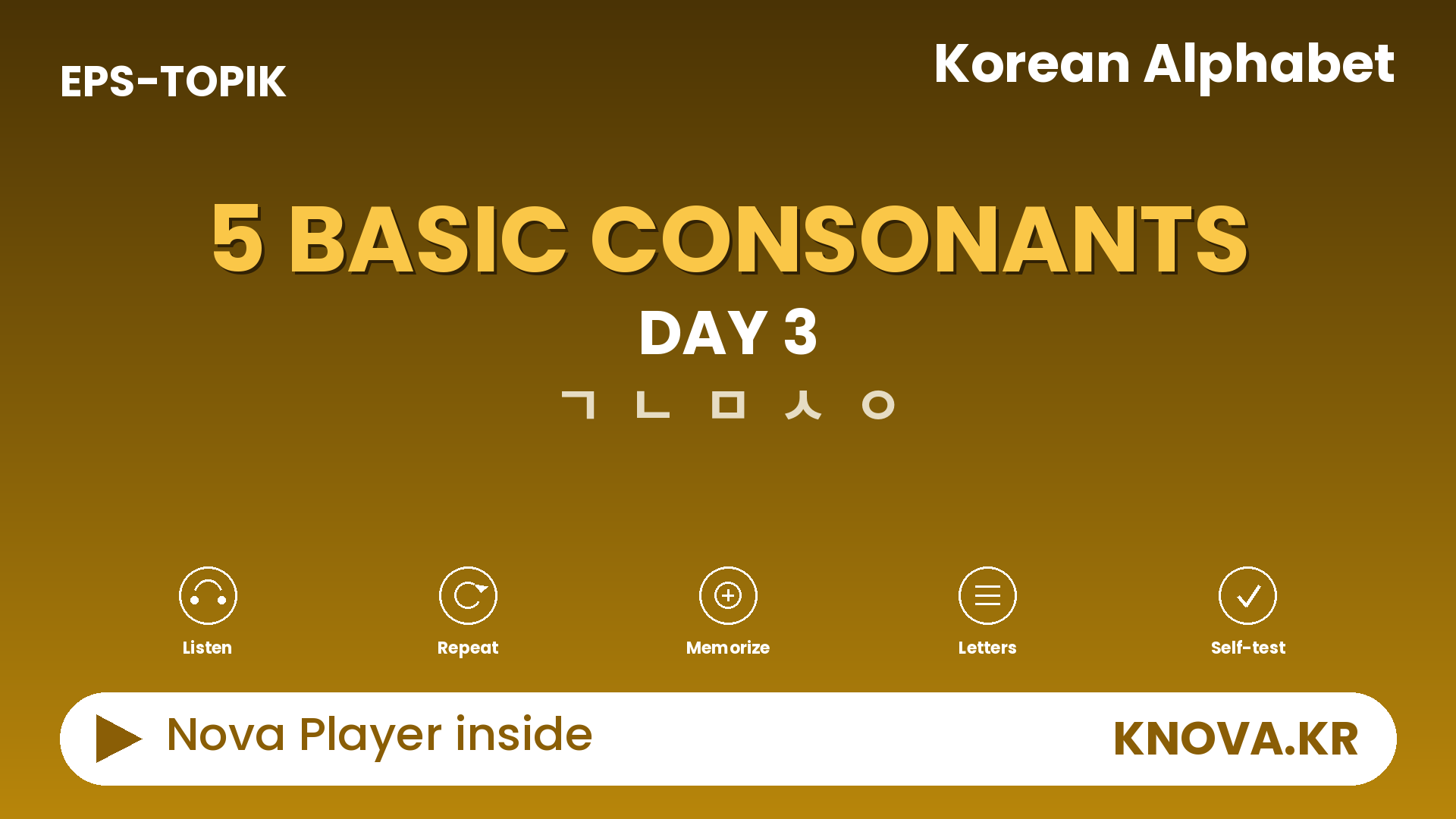
Welcome to Day 3 of the Korean Alphabet Master series! You’ve already mastered all 10 basic vowels — now it’s time for the 5 Basic Consonants: ㄱ, ㄴ, ㅁ, ㅅ, ㅇ. These are called the “root” consonants because every other Korean consonant is built from these 5 shapes. The secret is that each letter was designed to look like the shape of your mouth, tongue, or throat when you make that sound! Let’s discover the story with Teacher Nova.
TAG: Maligayang pagdating sa Day 3 ng Korean Alphabet Master series! Na-master mo na ang lahat ng 10 basic vowels — ngayon naman ang 5 Basic Consonants: ㄱ, ㄴ, ㅁ, ㅅ, ㅇ. Tinatawag itong “root” consonants dahil dito nagmula ang lahat ng ibang katinig sa Korean. Ang sikreto ay bawat letra ay dinisenyo para magmukhang hugis ng bibig, dila, o lalamunan mo kapag ginagawa mo ang tunog na iyon! Tuklasin natin ang kwento kasama si Teacher Nova.
🚨 If you came from Facebook: Tap [⋮] on the top right and select “Open in external browser” to enable sound!
⚡ Teacher Nova’s Core Rule
ENG: Unlike vowels, consonants CANNOT make a sound by themselves — they always need a vowel attached. So as you listen to the Nova Player below, notice that each consonant is pronounced together with the vowel “eu” (ㅡ), like “geu, neu, meu, seu”. This is simply the sound of the letter itself, not a real word!
👉 Now, practice with the Nova Player below, and read the story of each letter’s shape at the bottom of the page!
TAG: Hindi tulad ng mga patinig, hindi makakagawa ng tunog ang mga katinig nang mag-isa — laging kailangan nila ng kasamang patinig. Kaya habang nakikinig ka sa Nova Player sa ibaba, mapapansin mong ang bawat katinig ay binibigkas kasabay ng patinig na “eu” (ㅡ), tulad ng “geu, neu, meu, seu”. Ito ay tunog lang ng letra mismo, hindi isang tunay na salita!
👉 Ngayon, mag-practice gamit ang Nova Player sa ibaba, at basahin ang kwento ng hugis ng bawat letra sa ibaba ng page!
💡 Learn the Details: The Story of Hangul (Basic Consonants)
1. The Back of the Throat: ㄱ
ENG: The letter ㄱ is shaped like the root of your tongue blocking your throat — exactly the position your tongue makes when you say the ‘G’ sound in “Gun”. Look in a mirror and say “guh” slowly — you’ll feel the back of your tongue rise and touch the top of your throat, just like the bent shape of ㄱ!
TAG: Ang letrang ㄱ ay may hugis ng ugat ng iyong dila na humaharang sa iyong lalamunan — eksaktong posisyon ng dila mo kapag sinasabi mo ang tunog na ‘G’ sa “Gun”. Tumingin sa salamin at sabihin ang “guh” nang mabagal — mararamdaman mong tumataas ang likod ng iyong dila at humihipo sa itaas ng iyong lalamunan, tulad ng nakabaluktot na hugis ng ㄱ!
2. Tongue Tip & Closed Lips: ㄴ & ㅁ
ENG: ㄴ is shaped like the tip of your tongue touching the back of your upper front teeth — just like the ‘N’ sound in “Nose”. ㅁ is shaped like a closed mouth, a perfect square — exactly like the ‘M’ sound in “Mouth”, where your lips press completely shut.
TAG: Ang ㄴ ay may hugis ng dulo ng iyong dila na dumidikit sa likod ng iyong itaas na ngipin — tulad ng tunog na ‘N’ sa “Nose”. Ang ㅁ ay may hugis ng nakasarang bibig, isang perpektong parisukat — eksaktong tulad ng tunog na ‘M’ sa “Mouth”, kung saan ang iyong mga labi ay ganap na nagsasara.
3. Sharp Teeth & the Round Throat: ㅅ & ㅇ
ENG: ㅅ is shaped like a sharp tooth — just like the ‘S’ sound in “Smile”, where air hisses out between your teeth. ㅇ is shaped like a round, open throat. When ㅇ comes at the very start of a syllable, it is completely silent — it’s just a placeholder shape, so a Korean syllable never starts with a “naked” vowel alone.
TAG: Ang ㅅ ay may hugis ng matalim na ngipin — tulad ng tunog na ‘S’ sa “Smile”, kung saan may sumisitsit na hangin sa pagitan ng iyong ngipin. Ang ㅇ ay may hugis ng bilog, bukas na lalamunan. Kapag ang ㅇ ay nasa pinakasimula ng isang pantig, ito ay ganap na walang tunog — isa lang itong placeholder na hugis, kaya ang isang Korean syllable ay hindi kailanman nagsisimula nang “hubad” na patinig lamang.
👉 Ready for the Next Step?
ENG: You’ve mastered the 5 root consonants! Now, let’s add one stroke to each and learn 9 expanded consonants (ㅋ, ㄷ, ㅌ, ㄹ, ㅂ, ㅍ, ㅈ, ㅊ, ㅎ).
TAG: Natutunan mo na ang 5 root consonants! Ngayon, magdagdag tayo ng isang guhit sa bawat isa at pag-aralan ang 9 expanded consonants (ㅋ, ㄷ, ㅌ, ㄹ, ㅂ, ㅍ, ㅈ, ㅊ, ㅎ).