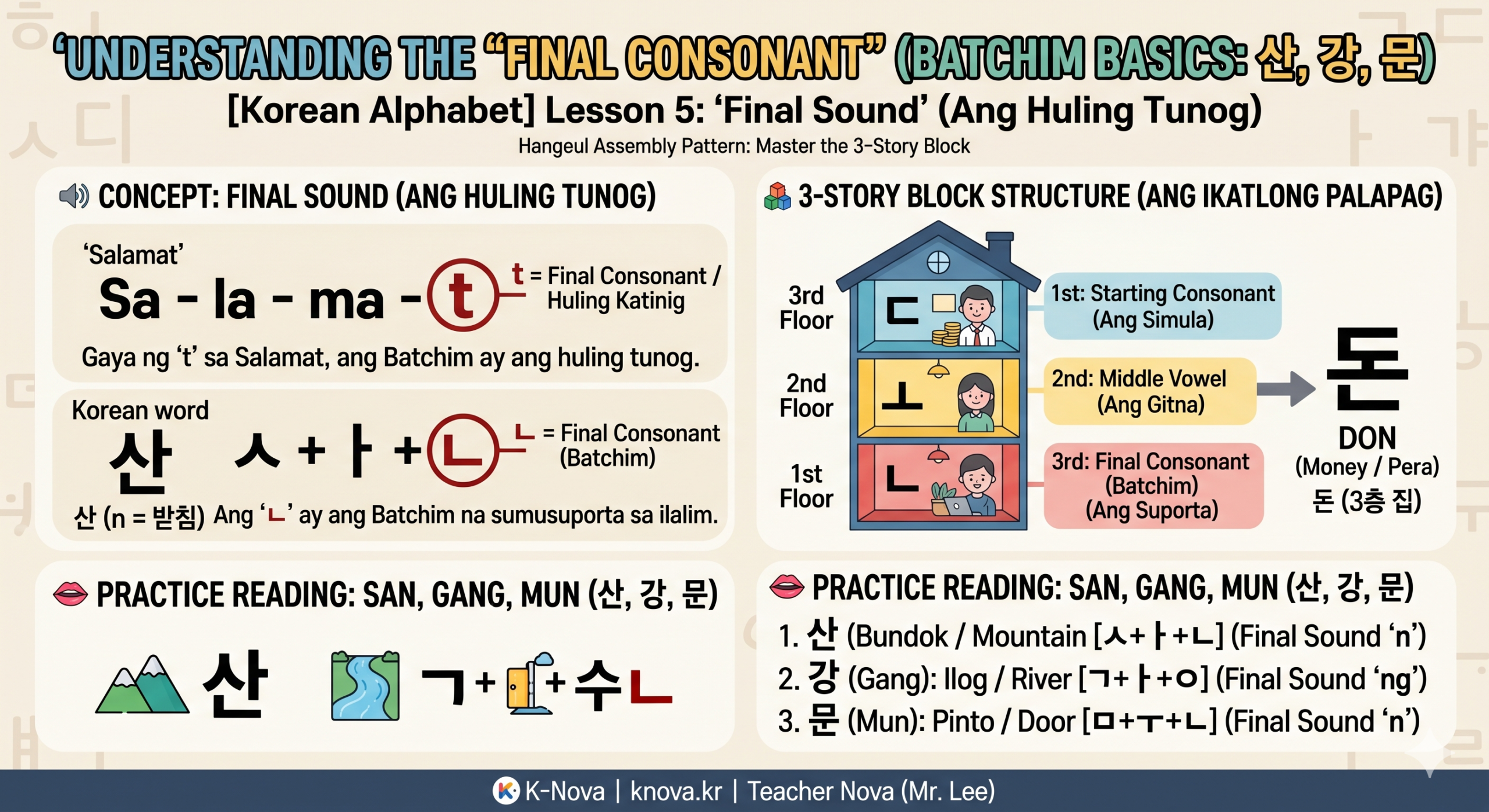
안녕하세요! Teacher Nova입니다. 오늘은 한글 공부의 핵심 중 하나인 Understanding the Final Consonant (Batchim) 과정을 통해 글자의 소리를 완성하는 법을 배워보겠습니다.
Welcome back to K-Nova! I am Teacher Nova. Today, we focus on Understanding the Final Consonant, which we call “Batchim” in Korean. Up until now, we’ve learned how to combine a consonant and a vowel. But to truly read Korean words like a pro, you must know how to “close” the sound of a syllable using a final consonant.
Maligayang pagbabalik sa K-Nova! Ako si Teacher Nova. Ngayong araw, magpopokus tayo sa Understanding the Final Consonant, o ang tinatawag nating “Batchim” sa Korean. Natutunan na natin kung paano pagsamahin ang katinig at patinig. Ngunit para makabasa ng Korean nang tama, kailangan ninyong malaman kung paano “isara” ang tunog ng isang pantig gamit ang huling katinig.
1. The Concept: What is a Final Consonant?
To begin Understanding the Final Consonant, let’s look at a very familiar Tagalog word: “Salamat”. Notice the sound at the very end.
– Sa – la – ma – t
The letter ‘t’ is the final consonant that closes the word. In Korean, we have the same concept. However, instead of writing it next to the vowel, we place it at the bottom of the syllable block.
따갈로그어 ‘Salamat’의 마지막 ‘t’ 소리처럼 음절의 끝을 맺어주는 소리를 ‘받침’이라고 합니다. 한글에서는 이 마지막 소리를 옆이 아닌 ‘아래’에 적는다는 것을 기억하세요.
Sa inyong pag-aaral para sa Understanding the Final Consonant, isipin ang salitang “Salamat.” Ang ‘t’ sa dulo ay isang final consonant. Sa Korean writing, hindi natin ito isinusulat sa tabi; inilalagay natin ito sa ilalim ng block. Ito ang sikreto ng Hangeul!
2. Building Blocks with 5 Basic Consonants (ㄱ, ㄴ, ㅁ, ㅅ, ㅇ)
You don’t need new letters yet! We can start Understanding the Final Consonant using the 5 consonants we already know. Look at these 3-story houses:
- 산 (San) – Mountain / Bundok: [ㅅ + ㅏ + ㄴ]
The ‘ㄴ’ (n) sound is the final consonant at the bottom. - 강 (Gang) – River / Ilog: [ㄱ + ㅏ + ㅇ]
The ‘ㅇ’ at the bottom sounds like ‘NG’ (parang sa ‘Saging’). - 문 (Mun) – Door / Pinto: [ㅁ + ㅜ + ㄴ]
The ‘ㄴ’ is the support that completes the word ‘Mun’.
Kahit 5 consonants pa lang ang alam natin, marami na tayong mabubuong salita gaya ng 산, 강, at 문. Ito ang unang hakbang para sa Understanding the Final Consonant basics. Napaka-simple lang, ‘di ba?
3. Why is it called “Batchim”? (Ang Kahulugan ng Suporta)
In Korean, the word Batchim (받침) means “support” or “floor.” It is called this because the final consonant supports the entire character from below. Think of it as the foundation of your building. This structural understanding is key to Understanding the Final Consonant and reading Hangeul faster.
‘받침’은 무언가를 받쳐준다는 뜻입니다. 글자의 맨 아래에서 다른 자음과 모음을 든든하게 받쳐주기 때문에 붙여진 이름이죠. 이 원리를 알면 한글이 훨씬 더 논리적으로 보일 것입니다.
Ang salitang Batchim ay nangangahulugang “suporta.” Dahil ito ang huling katinig, ito ang nagsisilbing “sahig” ng buong letra. Ang pag-intindi sa istrukturang ito ay mahalaga sa Understanding the Final Consonant journey niyo.
4. Practice Reading: San, Gang, Mun (산, 강, 문)
Let’s practice Understanding the Final Consonant with these words. Try to feel the sound closing at the bottom of your throat or mouth.
- 안 (An): Inside / Loob – (ㅇ + ㅏ + ㄴ)
- 삼 (Sam): Three / Tatlo – (ㅅ + ㅏ + ㅁ)
- 곰 (Gom): Bear / Oso – (ㄱ + ㅗ + ㅁ)
- 상 (Sang): Table or Prize / Mesa – (ㅅ + ㅏ + ㅇ)
Teacher Nova’s Summary
By now, you should have a better time Understanding the Final Consonant. It’s not a new letter, just a new position! Practice writing the words 산, 강, and 문 today to get used to this 3-story structure. You are doing a great job! In the next lesson, we will complete all 14 basic consonants.
오늘 배운 ‘산, 강, 문’ 세 단어만 기억해도 받침의 절반은 이해한 것입니다. 한글은 퍼즐과 같습니다. Teacher Nova가 여러분의 성공적인 한국어 공부를 항상 응원합니다!
Kung naintindihan niyo ang ‘산, 강, 문’, malayo na ang mararating niyo! Ang Hangeul ay parang puzzle lang. Lagi kayong gina-guide ni Teacher Nova. Fighting!
– Teacher Nova 🦾