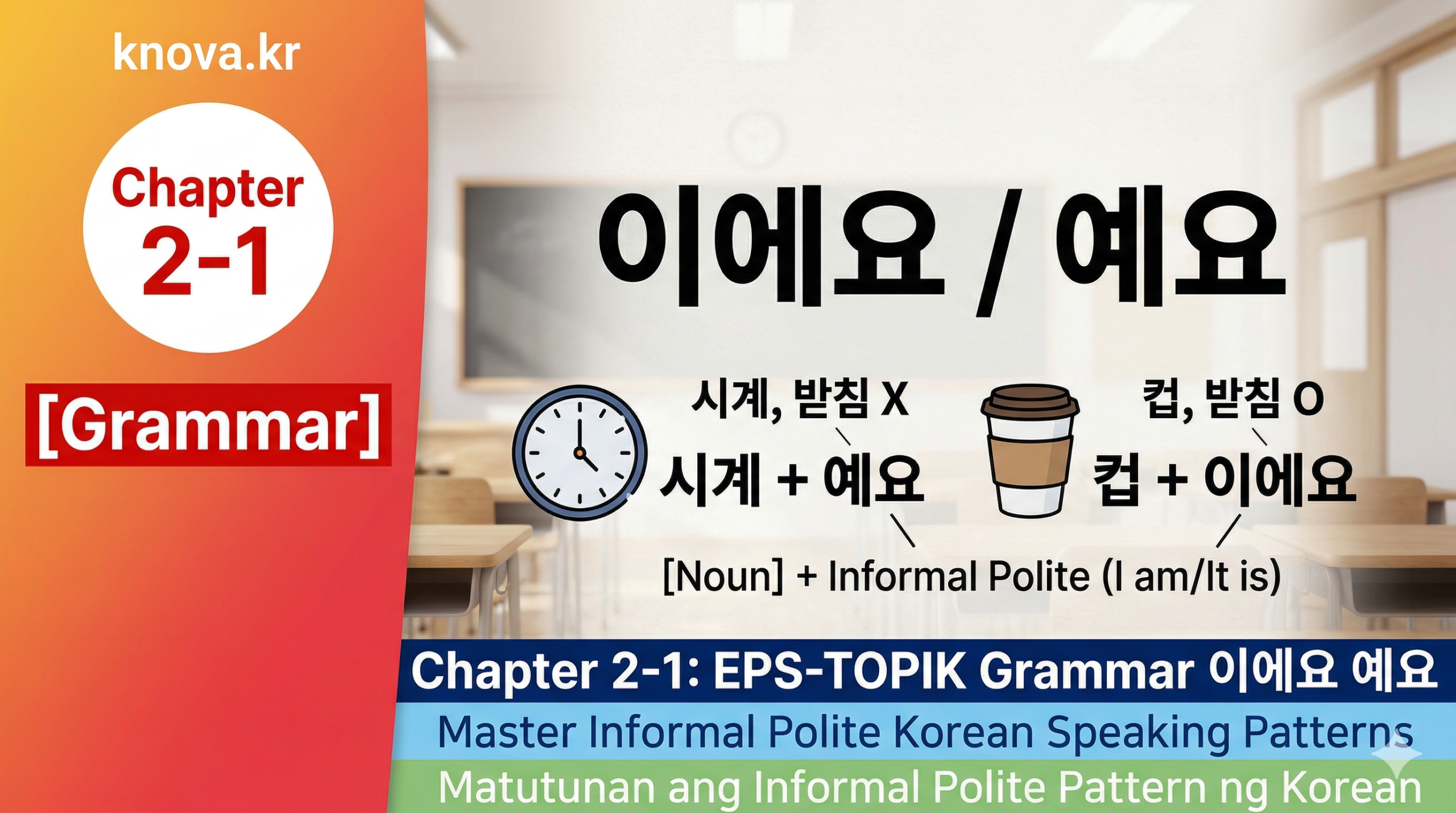
[Grammar] Chapter 2-1: EPS-TOPIK Grammar 이에요 / 예요
(Daily Necessities: This is / What is this?)
안녕하세요! knova.kr의 노바 선생님입니다. 오늘은 일상생활에서 물건의 이름을 묻고 답할 때 꼭 필요한 EPS-TOPIK Grammar 이에요 예요 ieyo yeyo 패턴을 배워보겠습니다.
Welcome! In this lesson, we will master the EPS-TOPIK Grammar 이에요 예요 ieyo yeyo pattern using “Office Supplies” vocabulary. This is used to identify objects in an informal but polite way.
Maligayang pagdating! Sa lesson na ito, pag-aaralan natin ang EPS-TOPIK Grammar 이에요 예요 ieyo yeyo pattern gamit ang mga salita para sa gamit sa opisina. Ito ang ginagamit para magpakilala ng mga bagay sa paraang informal pero magalang.
📢 오늘의 핵심 패턴 (Master Pattern)
[Noun] + 이에요 / 예요
- 이에요 / 예요: “입니다”의 비격식 높임말 버전입니다. 친구나 동료 사이에서 예의를 갖춰 말할 때 사용합니다.
The informal polite version of “입니다”. It is used with friends or colleagues to show respect.Ang informal polite version ng “입니다”. Ginagamit ito sa mga kaibigan o kasamahan sa trabaho para magpakita ng paggalang.
📖 핵심 포인트: 받침 유무 (Final Consonant Rule)
명사의 마지막 글자에 받침(Final Consonant)이 있는지 확인하세요!
- 받침 ○ (Final Consonant): Use 이에요 (i-e-yo)
예: 컵 (Cup) + 이에요 → 컵이에요 (Keop-i-e-yo)
- 받침 × (No Final Consonant): Use 예요 (ye-yo)
예: 시계 (Clock) + 예요 → 시계예요 (Si-gye-ye-yo)
사실 한국 사람들은 이 규칙을 머리로 계산하지 않아요! 발음이 편한 쪽을 선택하다 보니 자연스럽게 정해진 것이죠.
심지어 많은 한국 사람들도 ‘이에요’와 ‘예요’를 구분하는 공식적인 규칙이 있다는 사실을 모르고 산답니다. 그저 입에 익은 대로 말할 뿐이죠.Actually, Koreans don’t think about “Final Consonant” rules when they speak. In fact, many Koreans don’t even realize that such a grammar rule exists!
Sa totoo lang, hindi na iniisip ng mga Koreano ang rule ng “Final Consonant” kapag nagsasalita sila. Sa katunayan, maraming Koreano ang hindi man lang alam na may ganitong grammar rule pala.
💡 실전 예문: 사무실 물건 (Office Supplies)
질문할 때는 끝을 살짝 올려서 발음하세요!
Raise the intonation at the end when asking a question!
Itaas nang bahagya ang tono sa dulo kapag nagtatanong!
1. 이건 뭐예요? (이-건 뭐-예-요?)
What is this? / Ano ito?
2. 시계예요. (시-계-예-요)
It is a clock. / Ito ay orasan.
3. 연필이에요. (연-필-이-에-요)
It is a pencil. / Ito ay lapis.
4. 볼펜이에요. (볼-펜-이-에-요)
It is a pen. / Ito ay bolpen.
5. 가위예요. (가-위-예-요)
It is a pair of scissors. / Ito ay gunting.
6. 계산기예요. (계-산-기-예-요)
It is a calculator. / Ito ay calculator.
7. 달력이에요. (달-력-이-에-요)
It is a calendar. / Ito ay kalendaryo.
✏️ 연습문제 1: 대화 완성하기 (Complete the Dialogue)
알맞은 대답을 이에요/예요를 사용하여 완성해 보세요.
Complete the answers using 이에요/예요.
Kumpletuhin ang sagot gamit ang 이에요/예요.
- 가: 이건 휴대폰이에요?
나: 네, 휴대폰이에요.(Yes, it is a cellphone.) / (Opo, ito ay cellphone.)
- 가: 태국 사람이에요?
나: 네, 태국 사람이에요.(Yes, I am Thai.) / (Opo, ako ay taga-Thailand.)
- 가: 이건 가위예요?
나: 아니요, 볼펜이에요.(No, it is a pen.) / (Hindi po, ito ay bolpen.)
- 가: 요리사예요?
나: 아니요, 의사예요.(No, I am a doctor.) / (Hindi po, ako ay doktor.)
✏️ 연습문제 2: 말하기 미션 (Practice Mission)
아래 단어들을 사용하여 문장을 소리 내어 말해 보세요.
Say the following sentences out loud.
Sabihin ang mga sumusunod na pangungusap nang malakas.
- 컴퓨터 (Computer) → 이건 컴퓨터예요.
(This is a computer.) / (Ito ay computer.) - 안경 (Glasses) → 이건 안경이에요.
(This is a pair of glasses.) / (Ito ay salamin sa mata.)
- 컵 (Cup) → 이건 컵이에요.
(This is a cup.) / (Ito ay tasa.)
- 칼 (Boxcutter) → 이건 칼이에요.
(This is a boxcutter.) / (Ito ay cutter.)
Learn Practical Korean Patterns with Teacher Nova!
Visit: knova.kr | Facebook: Nova’s EPS Korean
출처: 한국산업인력공단 EPS-TOPIK 표준교재 (Teacher Nova 재구성)
Source: HRD Korea Standard Textbook for EPS-TOPIK, simplified and rearranged by Teacher Nova.
Pinagmulan: HRD Korea Standard Textbook para sa EPS-TOPIK, pinasimple at inayos ni Teacher Nova.