
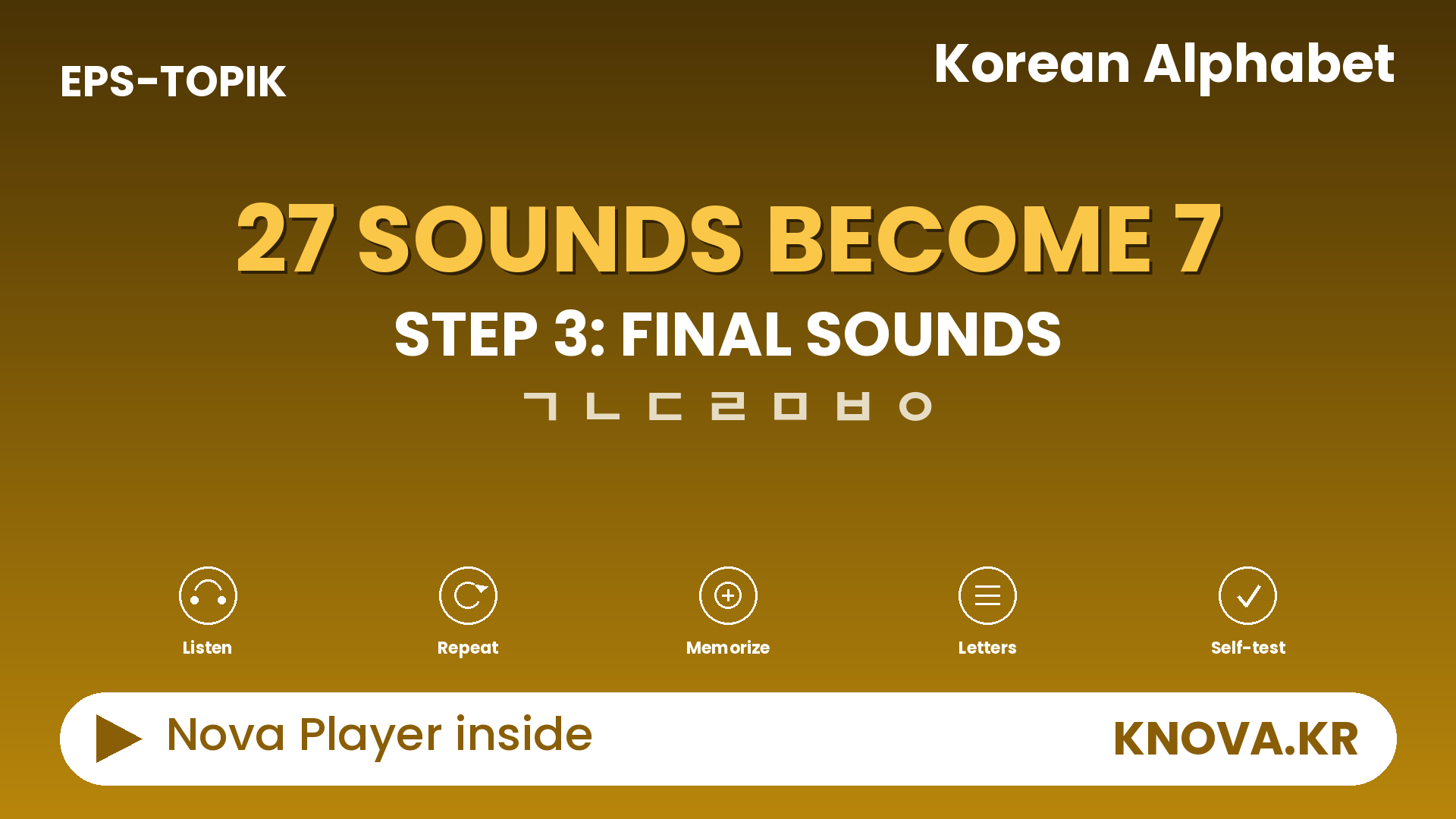
Welcome back! I am Teacher Nova. You’ve already learned how Batchim works with simple words like 산, 강, and 문. But here’s a surprising fact: Korean has 27 possible Batchim spellings — yet when you actually speak, they only ever make 7 Representative Sounds. Today, we’ll unlock this secret so that reading becomes much easier for you.
TAG: Maligayang pagbabalik! Ako si Teacher Nova. Natutunan mo na kung paano gumagana ang Batchim gamit ang simpleng salita tulad ng 산, 강, at 문. Pero narito ang isang nakakagulat na katotohanan: may 27 posibleng Batchim spelling ang Korean — pero kapag talagang nagsasalita ka, 7 Representative Sounds lang talaga ang nagmumula rito. Ngayon, bubuksan natin ang sikretong ito para mas madali kang makabasa.
💡 The Big Picture: 27 Spellings, Only 7 Sounds
ENG: No matter how a word is spelled, when you actually pronounce the Batchim, it always collapses into one of these 7 sounds. This is one of the most beautiful patterns in the Korean language!
TAG: Kahit paano man baybayin ang isang salita, kapag talaga mong binibigkas ang Batchim, palagi itong nauuwi sa isa sa 7 tunog na ito. Isa ito sa pinakamagandang pattern sa wikang Korean!
✅ Teacher Nova’s Mindset Tip
ENG: Please don’t try to memorize this whole list right now! Even most native Korean speakers couldn’t explain these rules if you asked them — they just grew up knowing the sounds. What you truly need is to get familiar with the 7 sounds and get a feel for how words are written. As you move forward into the real textbook lessons ahead, you’ll naturally absorb this pattern little by little, word by word. There’s no rush.
💡 Learn the Details: The 7 Sound Groups
1. Group [ㄱ]: ㄱ, ㄲ, ㅋ
ENG: Three different letters, one sound: ㄱ.
TAG: Tatlong magkaibang letra, iisang tunog: ㄱ. 국 (sabaw), 밖 (labas), 부엌 (kusina).
2. Group [ㄷ]: ㄷ, ㅌ, ㅅ, ㅆ, ㅈ, ㅊ, ㅎ (The Biggest Group!)
ENG: This is the largest group — 7 different letters, all becoming ㄷ. Watch this: the exact same base “나” changes meaning completely just by changing the Batchim, but it always sounds like [낟]!
TAG: Ito ang pinakamalaking grupo — 7 magkaibang letra, lahat nagiging ㄷ. 낟 (butil), 낱 (bawat isa), 낫 (karit), 낮 (araw), 낯 (mukha), 히읗 (pangalan ng letra).
3. Group [ㅂ]: ㅂ, ㅍ
ENG: Two letters, one sound: ㅂ.
TAG: Dalawang letra, iisang tunog: ㅂ. 집 (bahay), 숲 (gubat).
4. The Solo 4: ㄴ, ㄹ, ㅁ, ㅇ (No Grouping Needed!)
ENG: Good news — these 4 never change or group with anything. They always sound exactly like themselves.
TAG: Magandang balita — hindi kailanman nagbabago ang 4 na ito. Laging tunog nila mismo. 산 (bundok), 물 (tubig), 곰 (oso), 강 (ilog).
5. A Peek at Complex Batchim (겹받침)
ENG: Some words have TWO consonants stacked as Batchim (11 combinations total). The rule of thumb: usually only ONE of the two is actually pronounced.
TAG: May ilang salita na may DALAWANG katinig na nakapatong bilang Batchim (11 kumbinasyon sa kabuuan). Ang pangkalahatang tuntunin: karaniwan isa lang sa dalawa ang talagang binibigkas. 닭 (manok), 값 (presyo), 삶 (buhay).
🚨 If you came from Facebook: Tap [⋮] on the top right and select “Open in external browser” to enable sound!
⚡ Now, Test What You’ve Learned!
ENG: Press Listen and go through all 15 words below. Notice how differently-spelled words like 낟, 낱, 낫, 낮, 낯 all sound exactly the same — [낟]. This is your chance to really hear the pattern you just learned!
TAG: Pindutin ang Listen at dumaan sa lahat ng 15 salita sa ibaba. Pansinin kung paano ang magkakaibang spelling na 낟, 낱, 낫, 낮, 낯 ay pareho ang tunog — [낟]. Ito ang pagkakataon mong marinig talaga ang pattern na kakaaralan mo lang!
🎉 You’ve Completed the Entire Hangul Journey!
ENG: From the very first vowel to complex Batchim sounds — you now have every tool you need to read Korean. It’s time to start building real vocabulary!
TAG: Mula sa pinakaunang patinig hanggang sa complex Batchim sounds — mayroon ka na ngayong lahat ng kasangkapan para makabasa ng Korean. Panahon na para bumuo ng tunay na bokabularyo!